



What are the Christmas traditions in Mexico?
The month of December is often synonymous with snow, good spirits, convivial moments, and a return to childhood! In Western countries like France, the United States, or the United Kingdom, tradition dictates that the festivities last more or less three days: from December 24 to 26. In Mexico, this period unfolds differently since it spans almost an entire month and the conditions are not exactly similar to European customs. So, imagine celebrating this period from December 12 to January 6, with your feet in the sand at Playa Balandra, a glass of Tequila in hand. Strange, isn't it? ;)
Would you like to know more about the different Mexican traditions? Then follow us!
The start of the festivities with the "Posadas"
In Mexico, Christmas celebrations are above all religious. Everything begins with the tradition of the "Posadas." Associated with a series of processions in which both young and old participate, tradition dictates that every night for nine nights (from December 16 until Christmas Eve), family and close friends gather, as Mary and Joseph did in the inns during their journey.
The little ones, with a candle or a saint's statue in hand, head to their neighbors' homes to ask for hospitality. Upon arriving at the third house, tradition has it that the children receive charity. At home, the "pilgrims" sing Christmas carols, then the most devout Catholics go to midnight mass or the mass on December 25. Every year, Mexicans set up Christmas cribs or "Nacimientos Navideños" in their homes. In Mexico, tradition dictates that every dwelling has its crib, proof that they have indeed provided hospitality to Joseph, Mary, and baby Jesus.
The convivial moment of "Nochebuena"
Connected to the last evening of the Posadas, Nochebuena allows loved ones to attend midnight mass and then gather to share a traditional meal. For the curious, here is the menu (or *romerito navideño*): turkey stuffed with vegetables and raisins is the main course of the meal. It is accompanied by *quelites*, a wild plant similar to spinach. Mexicans season it with a *mole* sauce, a spiced chocolate, as well as a green apple salad. Other typical dishes are shared such as "tamales," parcels wrapped in banana or corn husks, "atole," a hot drink based on cinnamon, vanilla, cane sugar, and corn flour, "buñuelos," crispy fritters, and "ponche," a spiced fruit drink to which adults can add tequila.
On December 25, the tradition is to practice the *recalentado*, in other words, the "reheated meal." The next day, leftovers from the night before are reheated to finish the dishes. The goal: leave nothing in the fridge and, above all, do not waste!
Santa Claus in Mexico
As you will have gathered, Mexican traditions are very far from European customs. It is therefore baby Jesus himself who brings the Christmas gifts, which are then opened by the children on the 25th in the morning. If you visit Mexico during the holidays, you will have no chance of running into Santa Claus in the street. Apart from Christmas day, another gift distribution takes place on January 6, the date of Epiphany. The day before, children leave their shoes at the foot of the tree in the hope of receiving money when they wake up. Tradition dictates that baby Jesus be honored, as the Three Wise Men brought him birth gifts on this date. For the occasion, Mexican families share the "rosca," a king cake with fruit whose hidden charm is a figurine of baby Jesus. Traditionally, the person who finds it will have to pay for the "tamales" and "atole" for their loved ones during the Candlemas celebration on February 2. Indeed, during "El Día de la Candelaria," Mexicans take the baby Jesus from their Christmas crib to church to receive a blessing and share another family meal. This tradition still embodies an aspect of the Christian faith in Mexico because on January 6, it was the Three Wise Men who came to bring their gifts to the little Messiah who had just been born.
The Christmas tree... in the sun
A tradition originating from America, the Christmas tree is also meticulously decorated by Mexican families. When you are in Mexico for the Christmas holidays, you are not likely to be completely disoriented, even if seeing a decorated tree in such heat seems unusual! Indeed, far from the cold and grey climate of the European continent, the celebration takes place in a more exotic atmosphere with light and casual outfits. So, don't be surprised to cross paths with a superb Christmas tree while you are strolling on the white sand.
Saving the best for last: the Christmas piñata!
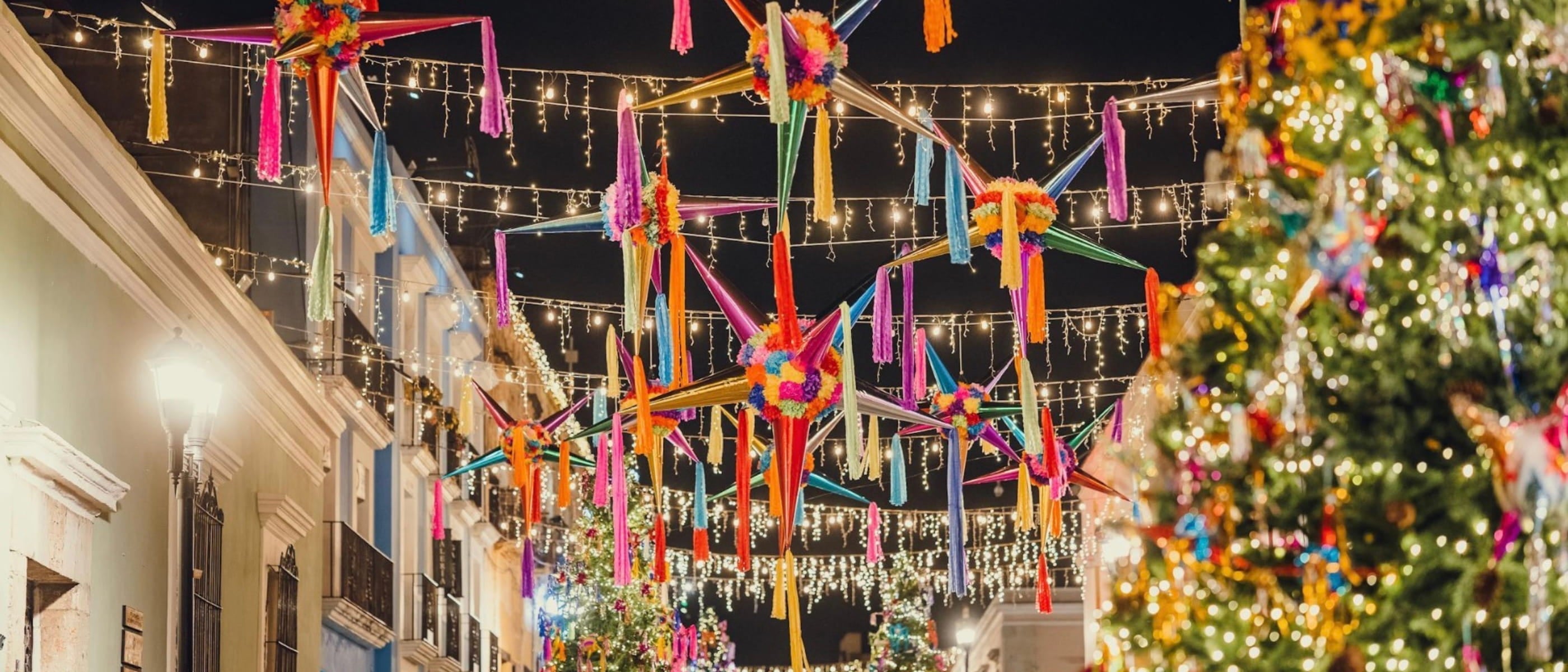
Of Chinese origin, the piñata in Mexico refers to the Christmas celebration. In Western countries, the piñata can take different forms. In Mexico, its shape is generally always the same: an imposing ball adorned with seven colored points representing the earth and its riches, and also referring to the seven deadly sins. The religious character dominates, and for the faith of Mexicans, the spiked ball aims to seduce man so that he sins. To resist temptation, man will therefore have to fight the devil. He is blindfolded, because he must walk by faith to the piñata (symbol of sin) which he will then try to break to defeat the devil. When he succeeds in releasing the candies and other treats inside, he has defeated the devil and now shares sweets as a token of hope and reward. It is on the last day of the Posadas, December 24, that the piñata is destroyed.
As you will have understood, Christmas in Mexico is synonymous with many Catholic traditions applied to the letter. Customs are very different across the world, but one thing is certain, at Mapache we are all looking forward to celebrating this year-end festival with our loved ones!