

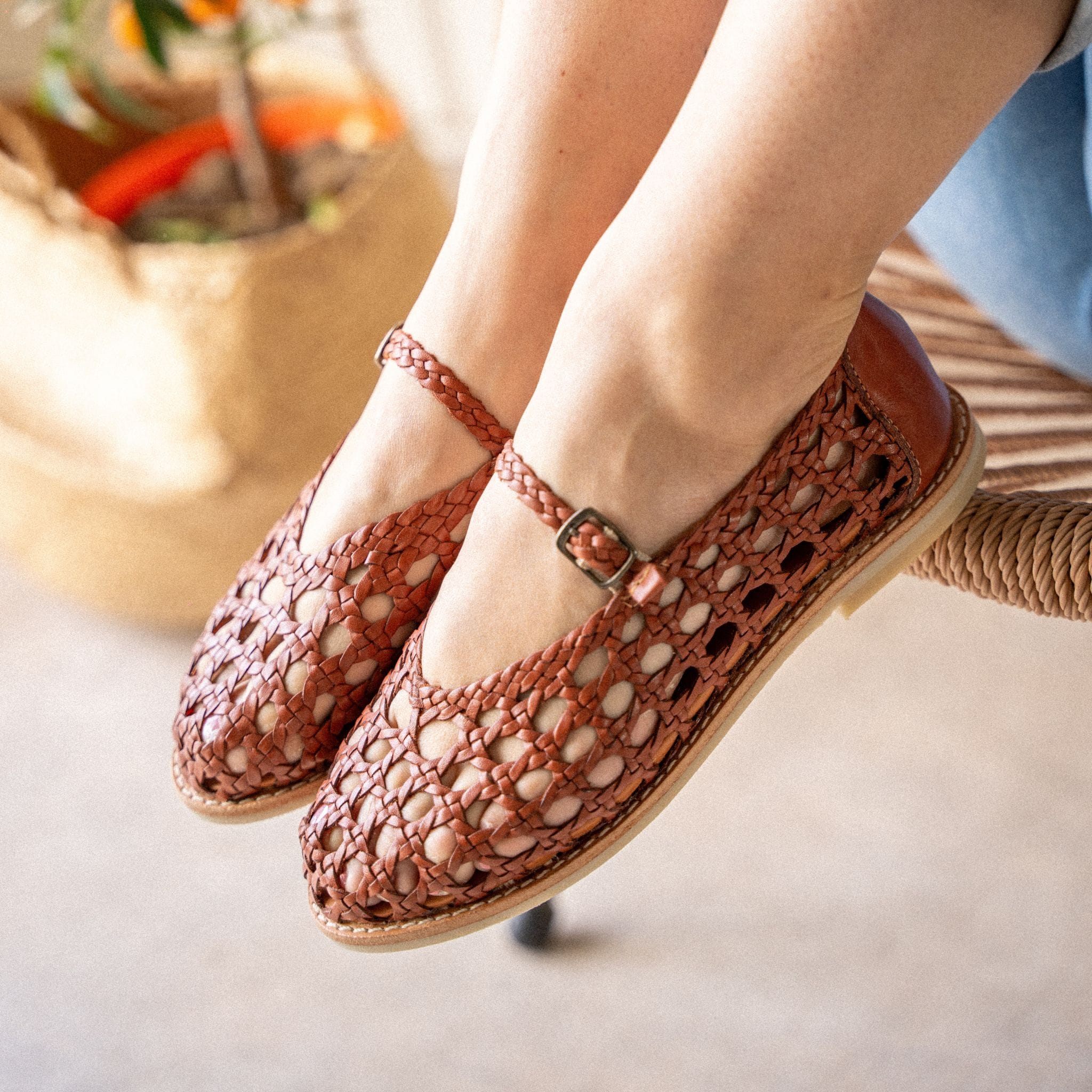
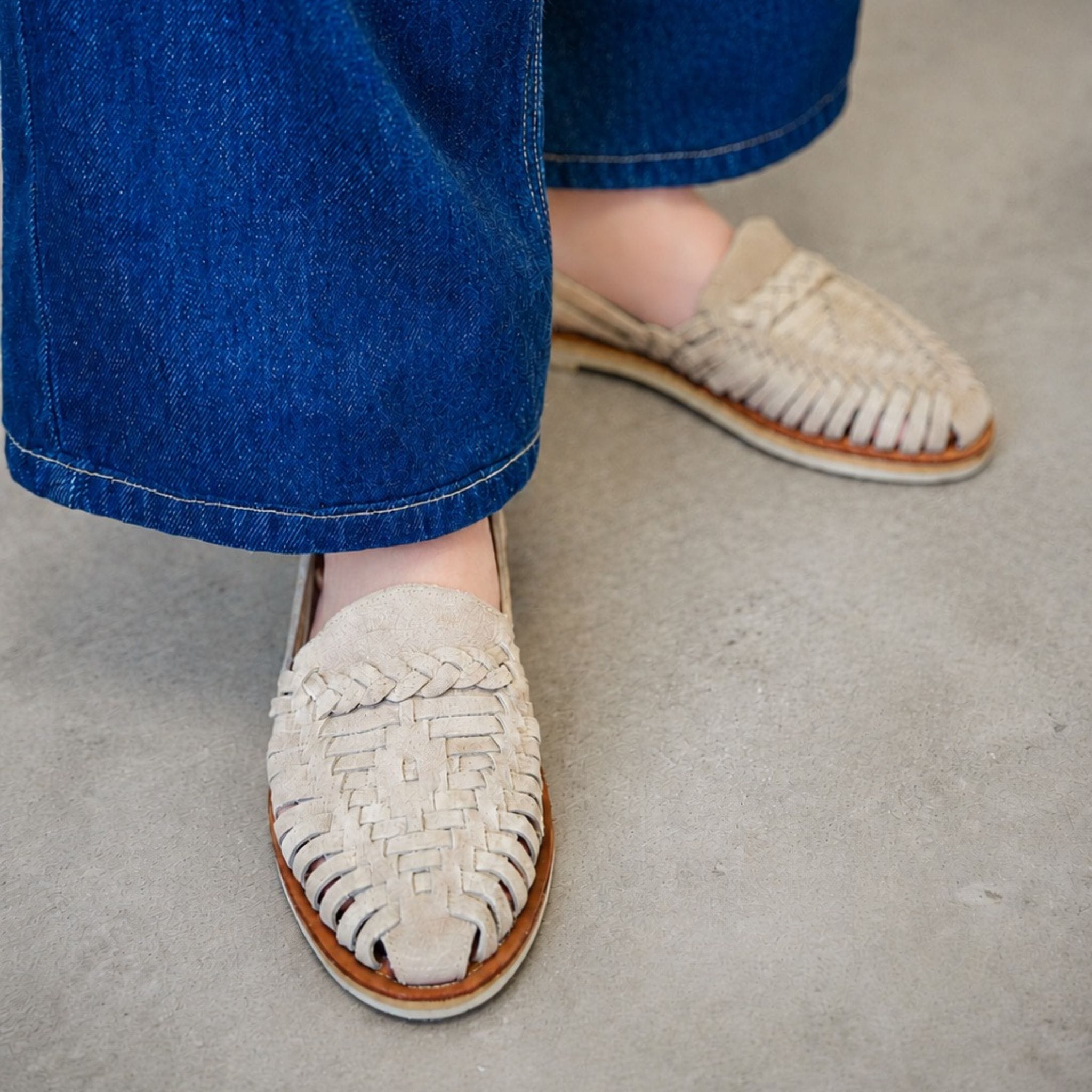


Article: Elizabeth, in Michoacán: a portrait of an artisan who weaves your huaraches

Elizabeth, in Michoacán: a portrait of an artisan who weaves your huaraches
When we talk about craftsmanship in Mexico, we often imagine vibrant workshops, colors everywhere, and expert hands working away in the heat of the south. That is partly true. But what we sometimes forget is that this handmade expertise also lives far from workshops, away from prying eyes, in the homes of the craftswomen. And it is precisely there, in Michoacán, that Elizabeth weaves the huaraches that you may already be wearing on your feet.
As we told you on our page dedicated to Mexican craftsmanship, leather weaving is a gesture passed down from mother to daughter for centuries. But behind the technique, there are women, families, and first names. Today, we want to introduce you to Elizabeth.
An artisan who works from home
Elizabeth does not make your sandals in a collective workshop. She makes them at home, in Michoacán, with her children by her side. This is a characteristic we are committed to preserving at Mapache: our craftswomen can work from their homes, at their own pace, without having to choose between their profession and their family.
For Elizabeth, it changes everything. Weaving from home allows her to earn a living without being far from her children. She organizes her days as she sees fit, and her hands continue to perpetuate a gesture she no doubt watched all through her childhood, before learning it in turn.
It is a reality we rarely see when buying a pair of shoes: behind every weave, there is a kitchen, a courtyard, perhaps a radio playing in the background, and children passing by from time to time to see what mom is doing.
Elizabeth introduces herself
A few minutes to get to know her. We'll let you listen to her words, they are worth more than our own.
The pride of knowing where her sandals go
What comes up most often when Elizabeth talks about her work is this word: pride. Pride in what she makes, pride in the result, and above all that special kind of pride in knowing that her sandals travel to the other side of the world.
Imagine: you are weaving, gesture after gesture, in your village in Michoacán. And a few weeks later, your work is on the feet of someone walking the streets of Lyon, Antwerp, or Geneva. Strange, and beautiful all at once.
Elizabeth told us on camera: thinking of you, who wear what she made with her hands, touches her. She is not manufacturing for an anonymous stock. She is manufacturing for someone. And this idea gives her work a dimension that far exceeds the technical gesture.
"Without you, I wouldn't be able to do this"
This is the sentence she told us. Spontaneously, at the end of the interview.
We share it because it says a lot about our approach since 2015. At Mapache, we sometimes have the feeling of "supporting" craftsmanship. But when we listen to Elizabeth, we understand that it is exactly the opposite. Without her and all our craftswomen, there would be no huaraches to weave, no iconic models, no brand at all.
What you buy from us is therefore not an object disconnected from those who make it. It is an economy that stands tall because every link—the artisan, the brand, the customer—plays its part.
What is really inside a handmade pair in Mexico
Now that you know a little about Elizabeth, you might look at your next pair of huaraches differently. The weaving under your fingers is what she (or one of her colleagues) did, strap by strap. The small, invisible variations from one pair to another are the discreet signatures of each artisan.
That is what handmade in Mexico is: not a marketing point on a label, but a network of real people, with first names, homes, and pride. And every pair that leaves their hands makes them exist a little more.
Everything you want to know about our artisans in Mexico
Where are Mapache sandals made?
All our sandals are made in Mexico, mainly in the state of Michoacán, where the huarache was born several centuries ago. This is also where Elizabeth and our other artisans hand-weave every pair you wear. To discover the details of the manufacturing stages, visit our craftsmanship page.
What exactly is a huarache?
The huarache is a Mexican pre-Columbian sandal, recognizable by its thin woven leather straps. Born in Michoacán, it has crossed the centuries thanks to expertise passed down from mother to daughter within indigenous communities. It is this heritage that we have been perpetuating at Mapache since 2015, by working hand in hand with artisans like Elizabeth.
Why do your artisans work from home?
Because it is the tradition, and because it allows them to reconcile their profession with their family life. Weaving at home is an integral part of huarache expertise: it is passed down between generations in homes, around a table, in the midst of daily life. For Elizabeth, as for our other artisans, it is also the possibility of earning a living without being far from their children.
How long does it take to make a pair of handmade sandals?
About 16 hours of manual labor per pair, divided into several stages: cutting the leather, weaving, hammering, drying, mounting, and assembly. Each step is carried out by hand by artisans specialized in their craft. This is why our huaraches are not just shoes, but the fruit of genuine artisanal work.
Walk with them
Now you know. You know where your huaraches come from, who makes them, and with what care. The next time you slip your feet into a pair of Mapache, think of Elizabeth, in her house in Michoacán. It is a bit of her gesture, and that of all our artisans, that you will take with you.
Discover the models hand-woven by Elizabeth and our artisans
Want to extend this trip to Michoacán with more than just your eyes? Slip your feet into one of our women's huaraches or let yourself be tempted by our iconic best-sellers, the same models that Elizabeth weaves daily. And if you are looking for the latest creations, the 2026 new arrivals have arrived.
